Surprising claim: a wallet that stops “blind signing” can materially reduce a large class of DeFi losses even if it doesn’t eliminate all risk. For American DeFi power users who move assets across dozens of EVM chains, the practical difference between a conventional extension and one that simulates transactions before signing is not just convenience — it reshapes how you reason about approvals, front‑running, and cross‑chain gas failures.
This article compares Rabby’s browser extension model to common alternatives, explains the mechanisms behind its chief protections, and surfaces the trade‑offs and boundary conditions that matter when you put real capital at stake. The goal is a sharper mental model: when simulation helps, when it can’t save you, and how to combine Rabby with other controls (hardware wallets, revocations, and multi‑sig) to lower operational risk.
What Rabby does differently: simulation, revocation, and automatic switching
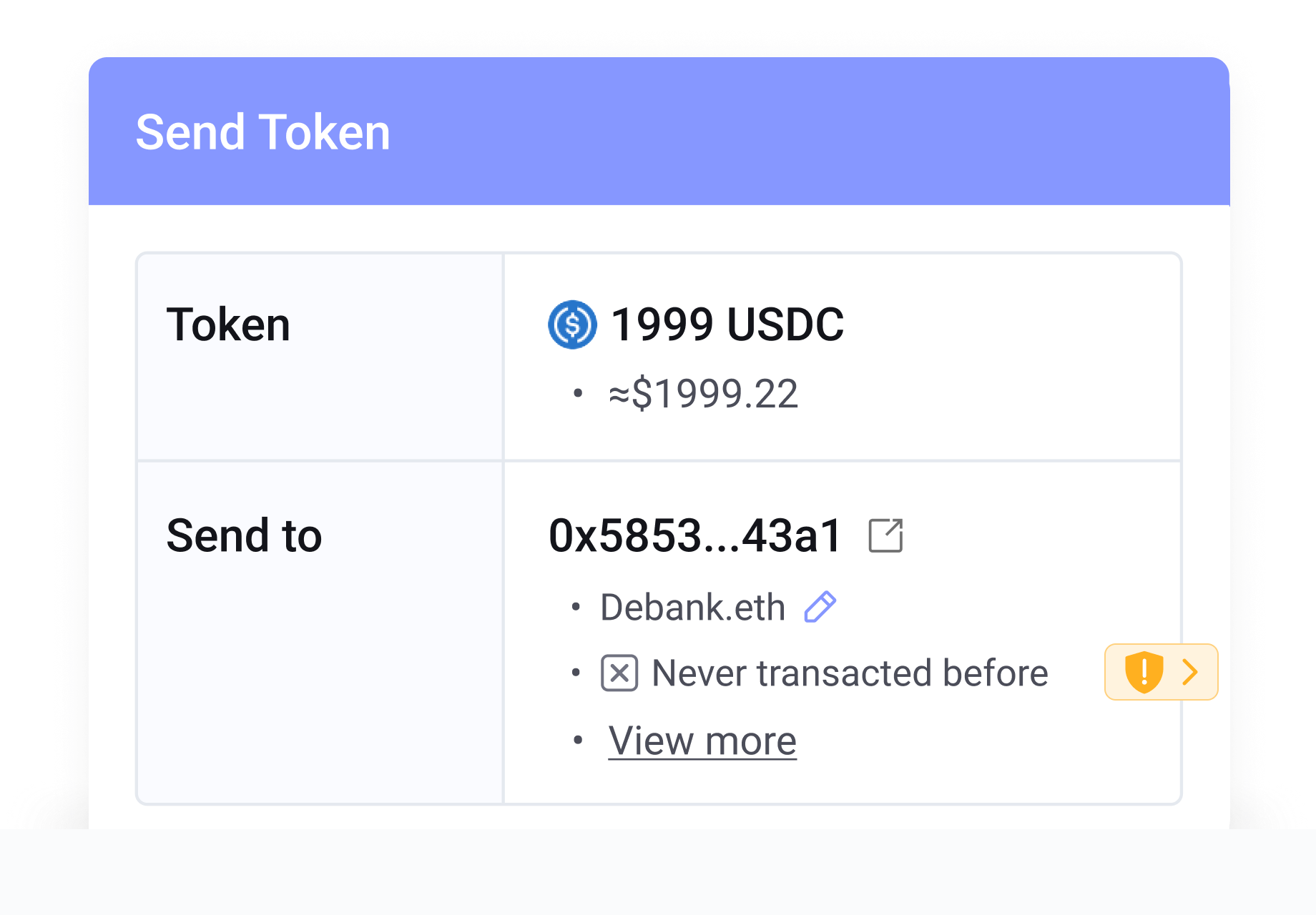
At the mechanism level there are three interlocking features that define Rabby’s threat‑model response. First, before a transaction is signed Rabby runs a local simulation and shows estimated token balance changes and explicit fee costs. That is a structural guard against “blind signing” — the scenario where a dApp requests a signature for a transaction whose side effects the user cannot inspect.
Second, Rabby embeds an approval revocation tool and a pre‑transaction scanner that flags interactions with contracts previously associated with hacks, suspicious approval requests, or missing recipient addresses. Third, it simplifies multi‑chain operational friction through automatic network switching and a cross‑chain gas top‑up feature so that users don’t have to manually move native gas tokens before interacting with a given chain. Together these mechanisms attack three common operational failure modes: accidental approvals, mis-sent transactions because of wrong networks, and poor visibility into complex contract calls.
Side‑by‑side: Rabby versus common EVM wallet alternatives
Compare Rabby to three familiar reference points: MetaMask (the de facto standard), Trust Wallet (mobile‑first), and Coinbase Wallet (user‑onboarding + custody bridge). What Rabby trades for its protections is clarity and operational features rather than novelty: the wallet is open‑source, supports hardware devices (Ledger, Trezor, Keystone, CoolWallet, GridPlus, BitBox02), and focuses on pre‑signing security rather than fiat on‑ramps or native staking.
Key contrasts that matter for a US‑based DeFi operator:
- Visibility vs ubiquity: MetaMask is the most universally supported but it historically lacked transaction simulation presented in human terms. Rabby adds that visible simulation layer; the trade‑off is that some dApps may have built flows optimized for wallets people already have installed.
- Operations vs onboarding: Coinbase Wallet blends fiat rails and custodial conveniences. Rabby deliberately lacks an in‑wallet fiat on‑ramp — a limitation if you want one‑click purchase inside the extension, but a security plus if you prefer to keep fiat interactions off the wallet device.
- Security controls: Rabby’s built‑in revocation and pre‑transaction risk scanning reduce exposure from token approvals. This does not make approvals unnecessary but it makes them visible and actionable in one UI.
These are not marketing claims; they are structural trade‑offs: you choose between maximal ecosystem compatibility and discrete, repeatable security primitives that change decision‑making at the point of signature.
Mechanics: how simulation reduces particular attack vectors — and where it doesn’t
Transaction simulation is conceptually simple but operationally powerful. The wallet reconstructs the intended call locally (or via a deterministic node), executes it on a simulated state, and returns the expected balance deltas and gas cost. That matters for common exploit patterns:
– Rogue approvals: A simulation can reveal a call that transfers tokens out or increases allowance beyond what you expected. If signed blindly, an approval can be leveraged later by a malicious contract.
– Malformed recipient or sandwich attacks: The simulation warns if the recipient is a zero or contract address that misbehaves. It doesn’t, however, prevent on‑chain sandwiching that happens between your simulated block and the included transaction if miners or bots front‑run it.
Where simulation does not help: it cannot undo vulnerabilities in the underlying smart contract logic or prevent losses when a private key is already compromised. Likewise, if an attacker tricks you into signing a transaction that appears benign in the simulated environment but exploits a legitimate on‑chain condition (for example, a flash‑loan‑driven state change that only exists at execution time), the simulation might not reveal the attack. Simulation reduces information asymmetry; it does not remove all creative, stateful attacks.
Operational best practices: combining Rabby’s features into a defensible workflow
For DeFi power users in the US who manage high‑value positions across multiple chains, a pragmatic workflow reduces human error and maximizes the value of Rabby’s tools:
1) Use hardware‑backed keys for hot interactions. Rabby’s wide hardware compatibility means your signing device can remain the final authority while the extension does heavy lifting of simulation and risk scanning.
2) Treat approvals as temporary permissions. Use Rabby’s revocation tool regularly—especially after one‑off AMM or bridge interactions—so that long‑lived allowances don’t become permanent exploit vectors.
3) Combine automatic network switching with explicit checks. Automatic switching cuts friction, but always verify chain and gas token displayed by the simulation before confirming. Chains and bridges can be spoofed in UI flows; Rabby reduces but does not eradicate social‑engineering risks.
4) Use multi‑sig or institutional custody for treasury and large holdings. Rabby integrates with Gnosis Safe and enterprise solutions; for institutional exposures, add a multi‑sig layer so that a single compromised key or extension misclick cannot drain funds.
Known limits and the honest trade‑offs
Rabby is not a silver bullet. Important, concrete limitations to factor into a risk model:
– No direct fiat on‑ramp. If you want to buy crypto with a debit card inside the wallet, Rabby doesn’t provide that native path — you’ll need an external exchange or custodial provider.
– No native staking UI. For chain‑native staking flows, you will either use separate staking dashboards or rely on third‑party dApps.
– Past incidents matter: a 2022 exploit of a Rabby Swap contract resulted in losses that the team addressed by freezing contracts and compensating users. The incident demonstrates two things: (a) security failures can come from associated contracts, not the wallet UI itself, and (b) remedial action and audits are part of operational resilience but not prevention of all future incidents.
Decision heuristic: when Rabby is the right wallet for you
Use Rabby if you: frequently interact with complex DeFi contracts across multiple EVM chains, want explicit transaction previews before signing, and prefer a browser extension that integrates hardware wallets and revocation tools. Consider alternatives if your top priorities are in‑wallet fiat purchases, native staking dashboards, or a single mobile‑first experience.
A simple rule of thumb: if you perform repeated, high‑stakes transactions where token flows and fee structure require inspection before commitment, a simulation‑first wallet like rabby meaningfully reduces cognitive load and the probability of accidental approvals. If your activity is occasional and centered on buying/selling through custodial rails, the usability trade‑offs may not justify switching.
What to watch next
Signals that would change the assessment: improved on‑chain privacy or MEV mitigations that make sandwiching less attractive would increase the practical value of pre‑execution simulation. Conversely, an emerging class of stateful attacks that exploit execution‑time conditions beyond what a simulation can reproduce would reveal a gap in the current defense model and prompt new mitigations (for example, time‑bounded multisig or additional signer confirmations tied to oracle states).
Also monitor whether Rabby expands native fiat partnerships or adds staking flows — such features would shift it closer to all‑in‑one wallets and alter trade‑offs for users balancing security against convenience.
FAQ
Does Rabby prevent all smart contract hacks?
No. Rabby reduces several human and UI risks (blind signing, accidental approvals, wrong‑network mistakes) through simulation and scanning. It does not remove risks inherent to buggy smart contract code, compromised private keys, or certain state‑dependent exploits that only manifest at execution time. Treat it as a strong operational control, not a complete security perimeter.
How does Rabby’s transaction simulation work with hardware wallets?
Rabby performs the simulation and risk checks in the extension, then routes the finalized transaction to the hardware device for signing. The hardware key signs the exact transaction the user inspected, keeping private keys offline. This combination keeps the signing authority out of the browser while preserving Rabby’s visibility features.
Can automatic network switching be dangerous?
Automatic switching reduces user friction but can hide subtle cross‑chain differences. Always confirm the chain and native gas token shown in the simulation before signing. If a dApp flow is suspect, switch networks manually and re‑verify the contract address and displayed token deltas.
Is Rabby suitable for institutional use?
Yes, as part of a layered approach. Rabby integrates with Gnosis Safe, Fireblocks, Amber, and Cobo Wallet. For institutions, use Rabby for visibility and simulation while placing custody or multi‑sig governance above it to ensure no single action can move significant capital.

Leave a Reply